Wealth Asset Advisor
Summer 2025
Volume 33 | No. 3
Market QuickTakes Q2 | 2025
Volatility, Recovery & Resilience
The second quarter of 2025 was one of the most volatile periods in market history, marked by extreme swings in sentiment driven by tariff policy shocks, inflation concerns, and economic uncertainty. It tested the resolve of even the most seasoned investors—requiring discipline, patience, and long-term perspective to weather the storm.
Markets entered Q2 under duress. President Trump’s surprise "Liberation Day" tariff announcement on April 2 triggered a swift and severe selloff, sending major U.S. stock indexes into bear market territory from 2025 highs. International markets were also severely impacted by the trade war escalation. The selloff reached its nadir within days, as recession probabilities soared to 50–60% and inflation expectations spiked to levels not seen since 2022. Then came an extraordinary reversal.
On April 9, following a sharp overnight spike in interest rates and bond market backlash, the administration announced a 90-day reciprocal tariff pause, calming markets almost instantly. U.S. stocks staged one of the sharpest single-day rallies in history, with 8–12% gains across major U.S. indexes. That single session accounted for over 80% of April’s total recovery, and by month-end, most indexes had recouped their losses, closing April in positive territory. International markets recovered sharply as well.
Momentum from the April 9 tariff pause rally carried through May and June, propelling the S&P 500 and Nasdaq to new all-time highs by quarter-end.

Key Q2 Highlights:
- Inflation and Recession Fears Spike, Then Ease
Recession risks surged to 50–60%, while inflation expectations spiked to post-2022 highs—both calming somewhat after the tariff pause. The Fed, though holding rates steady, acknowledged elevated uncertainty, slowing growth, and rising price pressures. - One of the Fastest Market Recoveries in Modern History
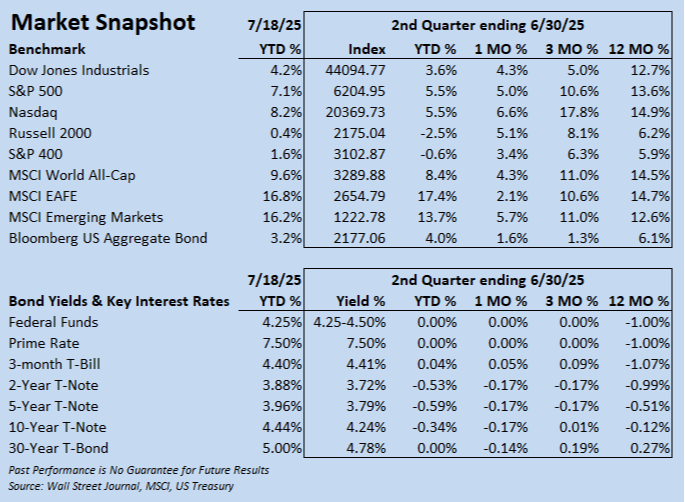
The tech-heavy Nasdaq, after a sharp 23.9% drawdown, closed Q2 up 5.5%, while the S&P 500, down 18.9% at its low, also finished the quarter up 10.6%—both ending the First Half at record levels. Whether measured by the Dow, S&P 500, or Nasdaq, the market recovery has been one of the fastest on record in modern history.
- Timing the Market: A Risky Game
Missing just one key day—April 9—meant missing a massive portion of the recovery. That single session delivered 8–12% gains across major U.S. indexes. By the end of April, it represented over 80% of the recovery gains. By quarter-end, more than one-third of total recovery gains had still come from that day alone. - Labor Market Holds Steady
Jobs data remained solid, with unemployment steady at 4.2% in May. Inflation reports (CPI and PPI) came in better than expected, supporting the market's bullish rebound, as recession risks eased, though remain elevated. - Strong Returns for Diversified and Resilient Investors
Despite volatility, Q2 delivered robust returns:
Nasdaq: +17.8% Q2 gain; closed Q2 +5.5% YTD
S&P 500: +10.6% in Q2; closed Q2 +5.5% YTD
MSCI EAFE (Developed Intl.): +10.9% in Q2; +17.4% YTD
MSCI EM (Emerging Mkts): +11.0% in Q2; +13.7% YTD
US Dollar Index: Fell 10.7% in the First Half, boosting foreign returns
Bloomberg Aggregate Bond Index: +1.6% in Q2; +4.0% YTD - Interest Rates Volatile, But Anchored
The 10-year Treasury yield closed Q2 at 4.24%, nearly flat, despite hitting a high of 4.59%. Long-term rates rose more meaningfully—30-year Treasury yields climbed 19 bps to 4.78%, reflecting debt concerns tied to proposed fiscal policy. - Geopolitical and Fiscal Pressures Rising
The Israel-Iran conflict added to market jitters, particularly in energy prices. Meanwhile, the prospect of the “One Big Beautiful Bill” (OBBB) raised fresh fiscal questions, with projections suggesting it may add $3–$5 trillion to the national debt over a decade (JPMorgan).
July Market Update: New Highs and Cautious Optimism
- Ongoing Rally
July has seen continued momentum, with the S&P 500 and Nasdaq posting additional gains of 2.6% and 3.0%, respectively, setting multiple all-time highs. The 90-day tariff pause announced on April 9, was extended to August 1, 2025. - Global Equities Mixed
Developed international markets have moderated slightly after strong First Half performance, though MSCI EAFE has also posted new highs. Emerging Markets continue to show strength amid a weaker dollar. - Fiscal Stimulus and Bond Market Reaction
President Trump’s OBBB Act was signed into law on July 4. While expanding tax cuts and fiscal stimulus, the projected long-term debt impact has unnerved bond markets, pressuring yields higher, especially on the long end of the curve. The Fed meets again July 29-30 and is expected to leave interest rates unchanged.
The Outlook: Volatility Remains the Constant
While the market’s resilience and speed of recovery have been encouraging, uncertainty remains elevated. Tariff policy, inflation dynamics, and geopolitical instability all suggest the potential for continued turbulence.
Investors are reminded that:
Missing even one key day can have long-term consequences. Staying invested, diversified, and disciplined is essential in volatile markets.
We continue to monitor developments closely and urge a balanced approach—remaining invested while prepared for near-term choppiness.
Financial Insights...
Guide to Market Volatility
Capital Group: "Given the uncertain environment, investors may have doubts about their investment approach. It’s natural to seek calmer shores when markets are choppy. But it’s equally important to step back, gain perspective and look toward the horizon.
History shows the stock market has always recovered from previous declines, though there’s no guarantee downturns will lead to rebounds. Here are five insights that can help you regain confidence and stay invested for the long haul."
- When in doubt, zoom out
- Markets typically have recovered quickly
- Bear markets have been relatively short-lived
- Bonds can offer balance when it is needed most
- Staying the course has paid off for long-term investors
Get all the details, charts, insights in Capital Group's Guide to Market Volatility below.
Past Performance is No Guarantee for Future Success
Principles for Successful
Long-Term Investing
JPMorgan: Eight time-tested strategies for guiding investors through today’s challenges and toward tomorrow’s goals:
- Plan on Living a Long Time
- Cash isn't always king
- Compounding makes a difference over time
- Avoid emotional biases and stick to a plan
and avoid the urge to time the market - Volatility is a normal part of being an investor
- Staying invested matters and helps to smooth out the investment ride
- Investing efficiently has its advantages
- Diversification works and it is a winning strategy over the long run
This detailed JPMorgan piece provides valuable insight into market volatility and how to stay focused for successful long-term investing.
Past Performance is No Guarantee for Future Success
Lessons Learned from
100 Years of Investing
MFS Funds: "In 1924, MFS® launched the US’ first mutual fund, bringing a diversified, professionally managed portfolio, formerly the privilege of the wealthy, to ordinary people. Since then, MFS has invested through 25 bear markets, 24 bull markets, 17 recessions, multiple market bubbles and many wars."*
We’ve learned many lessons along the way:
- Fundamentals matter
- Time is an investor’s greatest asset
- Diversification works
- Balance opportunity and risk
- Disruption is constant
- Teams over individuals
*As 12/31/24
Gain valuable insights from MFS' Lessons Learned from 100 Years of Investing below.
Past Performance is No Guarantee for Future Success
Heritage Planning
Our investment partner, MFS Investment Management created its Heritage Planning program of valuable information resources in 1996 to help investors address their unique financial concerns at every life stage. Nelson Securities has been providing our clients with these resources for nearly 30 years through our Wealth Asset Advisor newsletter and Financial Focus communications. Whether it's Planning for Retirement, Saving for College, Budgeting, Elder Care, or Estate Planning, any additional information investors can use to help address these concerns and plan for short-, intermediate-, and long-term goals can be helpful and valuable to our clients.
What Keeps You Up at Night? Checklist
The What Keeps You Up at Night? Checklist is a list of available materials Nelson Securities and our Advisors can provide. Just check the boxes of the items you would like to receive, enter your contact information, save the PDF, and email it to your Nelson Advisor and we will provide you with the requested materials.
Nelson Securities Legacy Planning Key Resource Guide - MFS Heritage Planning
The Nelson Securities Legacy Planning Key Resource Guide, courtesy of MFS Heritage Planning, contains Four Essential Legacy Planning Brochures that can help investors address and learn about the importance of having a plan to ensure that your loved ones are taken care of as you planned. It starts with a Review of Your Beneficiaries to make sure everything is current, and this topic is addressed in the Guide. You will find the following in the NSI Legacy Planning Key Resource Guide:
Nine Important Estate Planning Steps - Your estate plan can have an impact that reaches beyond financial issues and your lifestyle to include your family. Estate planning involves many complex concepts that are regulated by varying state laws as well as federal law.
Minimize Taxes With Estate Planning and Gifting - A comprehensive estate plan that includes gifting can help ensure your wealth is transferred according to your wishes and help you manage your estate’s tax bill. Estate tax and gifting rules are complicated, and this overview covers only a few of the many issues to consider.
Choosing Beneficiaries for Your Retirement Accounts - Who you choose as a beneficiary of your retirement accounts, and how you designate each beneficiary, can
have a significant impact on your family. Properly designating beneficiaries as part of your retirement planning process can help you contribute to the financial well-being of your heirs, giving them more options for how they receive the money and when those assets are taxed.
All Content is CLIENT APPROVED. Most brochures, guides, and presentations, are in PDF (Adobe Acrobat Reader), Microsoft PowerPoint, or video formats, which may require downloading the applicable program or player to view.
Mutual Fund & Annuity Center
Direct Mutual Fund and Annuity Models are Updated Semi-Annually
Our Direct Mutual Fund and Annuity Models are supported 100% Online. Click on the Model Portfolio Allocations Button below to access our Portfolio Allocations page. Password: 1029
Set up an appointment today with your Nelson Securities, Inc. Representative to review your investment portfolio.
800-345-7593
NOTE: WAA Summer 2025 Model Portfolio Allocations Q3-Q4 2025 (July-25: Direct Mutual Fund and Annuity Models Updated)
Investor Note
Mutual Fund and Variable Annuity investment strategies, which include investing in specific sectors, foreign securities (both developed and developing markets), high yield securities, or small and medium sized securities may increase the risk and volatility of the funds/sub-accounts. Changes in interest rates may affect the performance of fixed income (bond) funds; if rates increase, bond values decrease and vice versa. Investors should consider the investment objectives, risks, and charges and expenses of the Mutual Fund and/or Variable Annuity carefully before investing.
The Mutual Fund prospectus (and summary prospectus, if available) and Variable Annuity prospectus contains this and other information. Please read carefully before investing. A Mutual Fund prospectus and Variable Annuity prospectus and contract can be obtained by calling your Nelson Rep at 800-345-7593 or the Mutual Fund and/or Annuity company directly.
Publisher: Nelson Securities, Inc.
The WEALTH ASSET ADVISOR is published quarterly by Nelson Securities, Inc., a Registered Investment Advisor. All rights reserved. It is a violation of U.S. copyright laws to duplicate or reproduce any article or portion of this publication without the written permission of the publisher.
Information and historical market data contained within this newsletter are taken from sources we believe to be reliable but, we can not guarantee its accuracy. Nelson Securities, Inc., or the publisher, will not be held responsible for actions taken based wholly or partially on information contained herein. Recommendations are of a time-sensitive nature and not a substitute for a comprehensive plan for investing. Each investor must consider suitability with regard to risk prior to investing.