Market Commentary - September 2026
Read the Summer 2026 WAA for our Market QuickTakes, Q2 | 2026 Review, The Outlook, and Much More
September 2026
Stocks Reach New Highs in August Amid Strong Corporate Earnings
and Resilient Economic Data
August began with strong stock-market gains and new all-time highs before sentiment turned more cautious during the second half of the month. Renewed inflation concerns and rising interest rates tempered enthusiasm despite resilient economic data and strong corporate earnings.
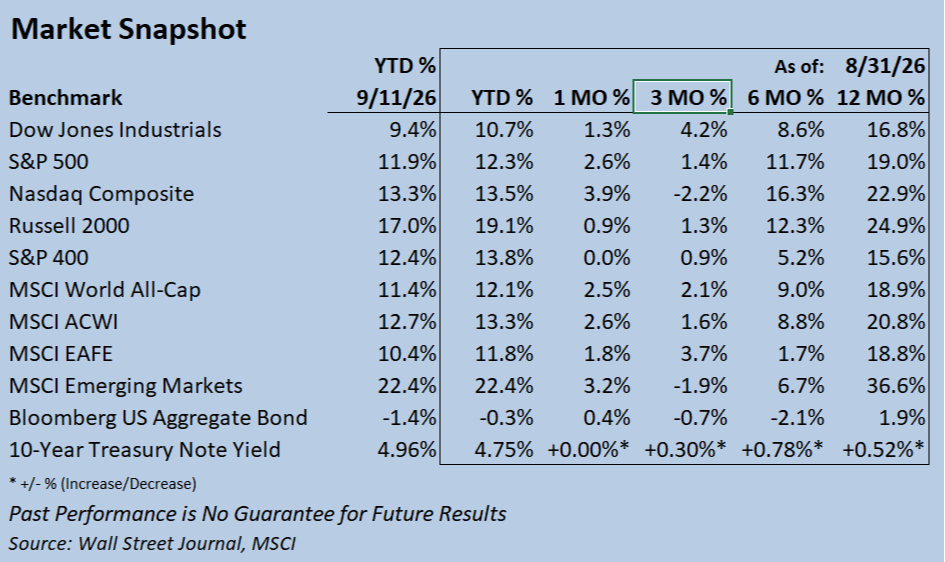
The technology-heavy Nasdaq led U.S. markets, gaining 3.9% on better-than-expected second-quarter earnings and renewed enthusiasm surrounding artificial intelligence. The S&P 500 advanced 2.6%, supported by its information technology weighting of more than 37%. Both indexes recorded their strongest August gains since 2021.
Market participation was more subdued beyond large-cap stocks. The Dow gained 1.3%, while the year-to-date leading Russell 2000 rose 0.9%. The S&P MidCap 400 was essentially unchanged. International markets strengthened, with the MSCI Emerging Markets Index rebounding 3.3% and the MSCI EAFE Index gaining 1.8%.
Economic and Interest-Rate Update
Economic data remained mixed but resilient. A second consecutive cooler inflation report was offset by elevated energy prices, geopolitical uncertainty surrounding the Iran conflict, and contrasting manufacturing and services readings. Meanwhile, second-quarter corporate earnings broadly exceeded expectations.
With U.S. government debt surpassing $40 trillion, investors also weighed conflicting policy signals. In his first Jackson Hole address as Federal Reserve Chair, Kevin Warsh reaffirmed the Fed’s commitment to its 2% inflation target and left the possibility of additional rate hikes on the table. At the same time, Treasury Secretary Scott Bessent announced plans to double the Treasury’s long-term securities buyback program in an effort to improve market liquidity, while increasing short-term debt issuance.
The benchmark 10-year Treasury yield rose sharply during August before ending the month near 4.75%, approximately where it began. The 30-year Treasury yield climbed to its highest level since 2007 and closed near 5.25%. Market expectations for a quarter-point Fed rate increase at its September meeting rose to approximately 65%.
The benchmark Bloomberg US Aggregate Bond Index edged higher in August by 0.4%, to finish down 0.3% YTD.
September Update
U.S. stocks have retreated modestly from their August all-time highs but remain within approximately 2%–3% of those record levels. Small- and mid-cap stocks have experienced steeper pullbacks of more than 5%. Overseas, developed markets have declined approximately 2%, while emerging markets have fallen nearly 4%. Brent crude oil’s rise to approximately $109 per barrel has added to global inflation concerns.
The European Central Bank raised its key policy rates by 0.25% on September 10, following a similar increase by the Bank of Japan in June. These moves underscore the broader shift toward tighter global monetary policy and reinforce the possibility of a similar move by the Federal Reserve.
With the Fed’s two-day September FOMC meeting set to conclude on September 16, markets have shifted in anticipation, accompanied by increased volatility. Investors have been digesting surging energy prices—with West Texas Intermediate crude oil climbing above $100 per barrel—and renewed inflation pressures. Although headline CPI largely matched expectations, core CPI and annual producer inflation came in slightly hotter than anticipated following two months of cooler readings.
In response, markets increased the probability of a September Fed rate hike to approximately 86%, up from 65% at the end of August and roughly 34% a month ago.
Treasury yields have risen across the yield curve in September. The benchmark 10-year Treasury yield reached 4.96%, its highest level since October 2023, while the 30-year Treasury yield climbed to 5.35%, its highest level since 2007. The benchmark Bloomberg US Aggregate Bond Index has slipped to -1.4% YTD.
Investor Perspective
August reinforced the market’s continuing tug-of-war between strong corporate fundamentals and persistent inflation and interest-rate risks, while preserving its hard-fought gains for the year. Market leadership returned to large-cap, AI-driven technology companies following a volatile two-month stretch. However, September has seen volatility rise with monetary policy uncertain, raised inflation concerns, higher interest rates, and valuations elevated, thus diversification across asset classes, market capitalizations, investment styles, and international markets remains as important as ever.
With the November 3 midterm elections approaching, periods of heightened volatility would not be unexpected. Nevertheless, we remain cautiously optimistic about the year-end outlook and encourage investors to remain disciplined, patient, and committed to their diversified, long-term investment strategies.
Key Takeaways for Investors
Remain well diversified.
Maintain discipline and patience.
Keep your focus on long-term objectives.
Consider year-end tax and financial-planning opportunities.
Periodically review your risk tolerance and portfolio allocation.
Call your Nelson Advisor today at 800-345-7593 to discuss any concerns or review your portfolio.
—Your Nelson Securities Team
Past Performance is No Guarantee for Future Results
This article is for informational purposes only and does not constitute investment advice.